AI-Powered Data Management for Startups: From Lead Tracking to VC Fund Databases
AI-powered data management enables startups to centralize lead tracking, customer data, and VC fund databases in one system, helping teams move faster and make smarter decisions.
Most startups begin with simple tools. A spreadsheet for leads. Another sheet for investors. A few notes saved in email threads. At first, this feels manageable.
Startups require smart, flexible ways of organizing data efficiently and reducing manual work with flexible database templates that adapt to their needs.
Then growth starts.
Leads come from multiple channels. Team members update data differently. Investor conversations get lost. Suddenly, data becomes a problem instead of an asset.
This is where AI data management starts to matter. Startups do not need heavy enterprise systems. Startups require smart, flexible ways of organizing data efficiently and reducing manual work.
AI-powered data management services help startups turn scattered information into structured databases for use.
What AI-Powered Data Management Really Means for Startups
AI-powered data management does not about replacing humans. It's about assisting teams in handling routine tasks, organizing information and identifying patterns more quickly.
For startups, this usually includes:
- Automatically organizing incoming data from forms, emails, and tools
- Keeping records clean and consistent without constant manual checks
- Helping teams find insights from growing datasets
Unlike traditional systems, AI adapts as data grows. It learns from patterns and improves accuracy over time.
This approach fits well with startups that change fast and need tools that grow with them.
Common Startup Data Challenges Before Using AI
Many founders recognize data problems only after they slow things down. These challenges appear across industries.
Here are some common ones:
- Leads stored in multiple places, causing missed follow-ups
- Investor data scattered across emails, notes, and spreadsheets
- No clear ownership of data updates across teams
- Time wasted cleaning and formatting records manually
Without AI data automation, teams spend more time managing data than using it.
AI helps reduce this friction by creating structure early, even when data volume is still small.
This approach lets non-technical teams benefit from AI without relying on developers. Curious about how this works for your team? Explore Stackby in a guided demo to see real-world examples.
Using AI for Lead Tracking Without Complex Systems
Lead tracking is one of the first areas where startups feel the pain of poor data management.
AI for lead tracking helps in simple but powerful ways. It captures lead information, categorizes it, and keeps it updated as interactions happen.
Instead of manually updating spreadsheets, teams can focus on conversations and conversions.
AI-powered lead tracking supports startups by:
- Automatically tagging leads based on source and behavior
- Detecting duplicates and merging records
- Highlighting leads that need immediate attention
With the right setup, startups gain a live view of their pipeline without constant manual effort.
Building a Reliable VC Fund Database with AI
Managing investor relationships requires precision. Missing details or outdated information can cost opportunities.
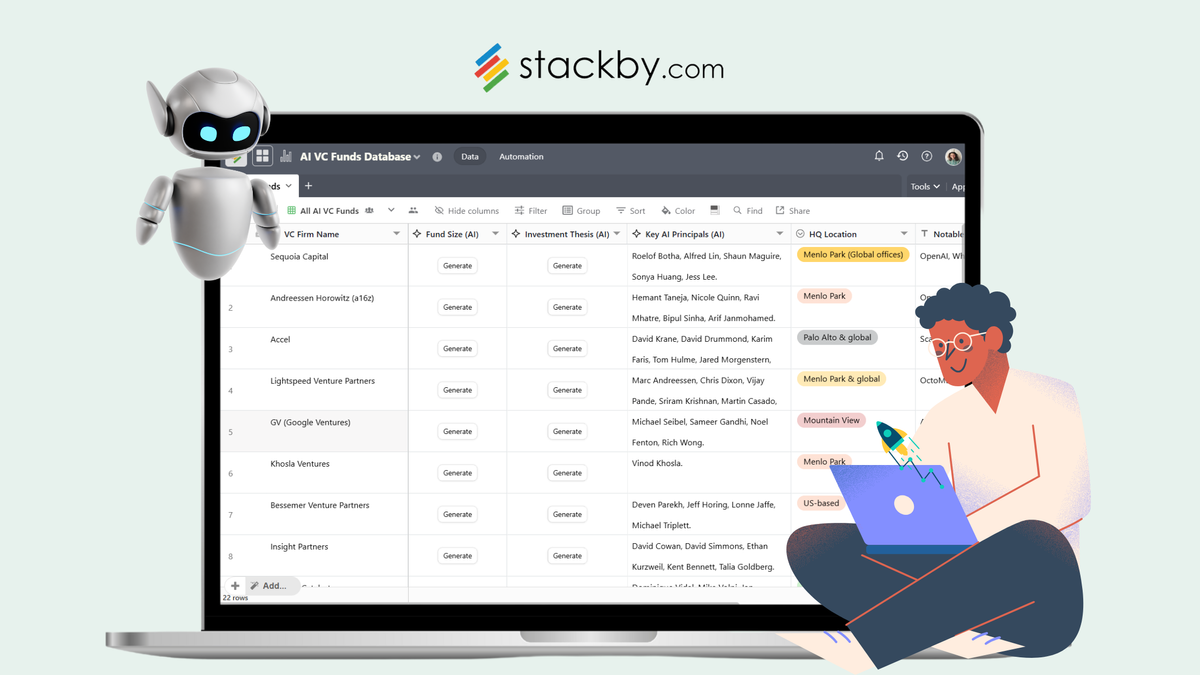
An ai vc fund database brings structure and clarity to this process. It helps founders track funds, partners, check sizes, stages, and communication history in one place.
AI adds value by identifying patterns across investor interactions and helping founders prepare smarter outreach.
A well-organized VC database allows startups to:
- Track investor preferences and past conversations
- Filter funds by stage, sector, and geography
- Maintain accurate and updated contact records
This becomes especially useful during fundraising when timing and clarity matter most.
How AI Database Tools Support Growing Startup Teams
As teams grow, more people touch the same data. This increases the risk of errors and inconsistencies.
AI database tools help maintain order without slowing collaboration. They work quietly in the background, ensuring data quality stays high.
These tools assist teams by:
- Standardizing data formats automatically
- Flagging incomplete or conflicting entries
- Suggesting updates based on usage patterns
This creates trust in data, which is essential for decision-making.
Managing Data Using AI Without Technical Complexity
Many founders worry that AI systems require technical expertise. In reality, modern no-code platforms remove this barrier.
How to manage data using AI today is less about coding and more about designing workflows that make sense.
Startups can use AI to:
- Auto-fill fields based on previous entries
- Connect tools and sync data across platforms
- Create smart views that update in real time
This approach lets non-technical teams benefit from AI without relying on developers.
Organizing Business Data with Flexible Templates
Templates play a big role in early-stage data organization. They provide structure while allowing customization.
AI tools for organizing business data typically are most effective when they are paired with templates that can be adapted to any needs. These templates function as the basis for a new design that is able to be modified as requirements change.
For instance, startups could manage leads and Calendars of content, CRM information and investor lists with structured databases that expand as they grow.
Many teams look into Stackby templates when establishing the first databases powered by AI since they blend spreadsheet experience with the flexibility of a database. This allows you to manage the increasing amount of data, without having to switch tools later on.
How Stackby Supports AI-Powered Data Management
Stackby is designed for teams that want clarity without complexity. It blends the simplicity of spreadsheets with the power of databases.
For startups, Stackby supports ai data management by allowing teams to build custom databases for leads, investors, projects, and operations in one workspace.
Stackby works well for teams that need control without rigid systems. To understand how these features can fit your specific startup needs schedule a live demo with our team.
Key ways Stackby helps include:
- Flexible data structures that adapt as startups scale
- Built-in automation to reduce manual updates
- Visual views that make data easier to understand
Stackby allows teams to create online databases for leads, investors, projects, and operations in one workspace.
Stackby works well for teams that need control without rigid systems.
Practical Ways Startups Use Stackby for Data Management
Startups use Stackby across different functions, often starting small and expanding over time.
Here are common use cases:
- Lead tracking databases that update automatically from forms
- Investor databases that centralize VC fund information
- Marketing and sales trackers that align teams
- Internal knowledge bases that grow with the company
These setups support daily operations while keeping long-term data organized.
Scaling Data Systems Without Rebuilding Everything
One of the biggest advantages of AI-powered platforms is scalability.
Instead of rebuilding systems every few months, startups can refine existing databases as needs change. AI supports this by learning from new data and adjusting automation rules.
This approach saves time and reduces disruption during growth phases.
Why AI Data Automation Matters for Decision Making
The best decisions are based on reliable information. AI data automation makes sure that the accuracy of information is timely and readily available.
This is for founders. It means less problems with blind spots and greater confidence in dashboards and reports.
Artificial Intelligence can assist in uncovering information buried deep within raw data sets, leading to more informed and strategic decision-making and execution.
Discover how other startups leverage AI-powered data management with our tailored startup solutions.
Conclusion: Turning Data Into a Startup Advantage
Data doesn't have to be a problem for entrepreneurs. If you follow the right strategy it can be an advantage in competition.
AI-powered data management allows startups to get more efficient, remain organized and make better choices from lead tracking to managing the VC fund's database. With the help of the flexibility of instruments, smart automation and flexible templates, entrepreneurs can develop data systems that can support expansion instead of slowing the process down.
Platforms such as Stackby help with this transition by providing no-code methods to manage large amounts of data without compromising the simplicity.
Platforms such as Stackby help with this transition by providing no-code approaches to manage large amounts of data without compromising simplicity. Want to see how it works in action?
To explore how AI-powered databases can transform your startup's data management.
![13 Best Business Management Software for your Work [2026]](/blog/content/images/size/w960/2024/03/stackby-business-blog-image-1.jpg)
![10 Best Free Database Templates for Marketing Agencies in [2026]](/blog/content/images/size/w960/2024/03/stackby-Database-templates-for-marketing-agencies-1-blog-post-2.jpg)