
AI Business Automation: Smarter Workflows to Scale Faster in 2026
AI business automation is transforming how companies operate in 2026. Learn how to build smarter workflows, automate repetitive tasks, and scale operations faster using tools like Stackby.
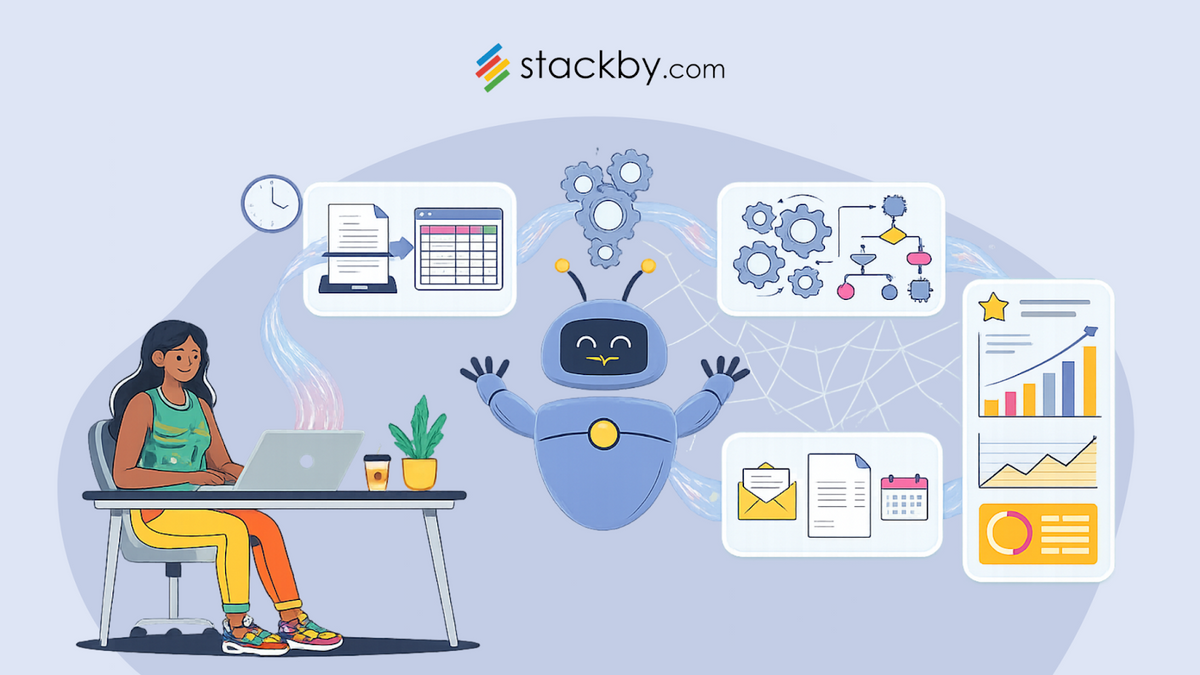
Imagine a Monday morning without any manual data entry or chasing your team for updates. Instead, you wake up, open your dashboard, and see an AI agent has already sorted new leads, sent follow-up messages, and updated your inventory predictions using a smart inventory management system based on sudden market changes.
This is not a fanciful dream; it is the minimum to be successful in 2026. The transition towards AI Business Automation as the replacement of the manual databases has become a tipping point.
As the AI market in the world is almost 2 trillion dollars, companies are ceasing to ask whether they should automate or not, and how to automate without losing the human touch. (Source: Forbes Research)
In this blog, we’ll look at what AI-driven business automation actually looks like in practice. It will show you how to deploy smarter workflows with Stackby to save your time, minimise errors, and even scale your operations at a scale and speed that used to be in the reach of tech giants. By the end, you will have a map that will help you shape your business into a machine that develops itself.
What is AI Business Process Automation?
The AI Business Process Automation (AI-BPA) is a union of doing and thinking in its simplest form. Consider it as a spreadsheet which has finally learned to think. In the old days, automation resembled a simple kitchen clock. It did one thing at a given time. It was rigid and easily shattered when your data was altered.
However, AI-based automation is far more intelligent. It applies Machine Learning with brains to analyze your data and learn what it entails. Rather than simply storing the email of a customer, an AI-driven system can read the message, sense the tone, and determine whether it is in an emergency.
And this is where Stackby enters and changes the game. Stackby isn't just a place to store your lists. Using it, you can transform your static rows into living workflows. You can set up columns which automatically summarize long meeting notes or can categorize leads without you having to lift a finger. It is a sort of a digital assistant in your database.
Benefits of Using AI in Automation
The 2026 figures are astronomical. Recent industry articles indicate that companies that have incorporated AI in their daily operations have experienced a productivity jump of more than 20 per cent (source: morganstanley.com research). With the relocation of your operations to Stackby, you will fill the void between simple spreadsheets and smart, self-executing workflows. Let's understand the reasons why this is important for your daily grind.
1. Sustainable & Competitive Advantage
AI does not work harder; it works smarter to ensure that you are ahead. With Stackby, you can create a centralised system for your data that is flexible to market changes. This offers a competitive advantage in the long term compared to competitors who are still stuck in manual silos.
2. New Business Model
AI facilitates the use of outcome-based models where you pay based on the outcome and not hours, often supported by structured frameworks like a business model canvas. Stackby makes this possible by giving you the visibility and real-time tracking of data to demonstrate those results to your clients.

3. Increase in Productivity
Automation is a time-bomb for your team. Industry data from Stackby users reveals that team productivity increased by more than half post-implementation. With the elimination of low-value tasks, your employees can concentrate on high-impact strategy.
4. Improve accuracy & reduce errors
The tedious process of data entry kills productivity and accuracy. Stackby removes this risk by syncing data with your favourite apps. This makes sure that your records are clean, consistent and totally devoid of human oversight errors.
5. Automate repetitive tasks
End the cycle of copy-pasting each and every week. With Stackby, you can automate status updates and team notifications with one click. This will save your team some time to focus on high-level growth and strategy.
6. Reduced operational cost
Reduction of overhead is critical for scaling. Automation can make businesses achieve an average ROI of 240 per cent, and the initial investment can be recovered within six to nine months. (Source: Symtrax Research)
These benefits show that AI is not just a luxury, but the new standard for efficiency. Centralising your data in Stackby will transform a passive database into an active engine that will drive your business forward each and every day.
Business Process Automation Strategies
You must have a strategy that focuses on your largest bottlenecks to really scale. This is the way that high-performing businesses are utilising AI at the moment.
1. Automating Customer Support with AI
We have moved beyond chatbots that simply respond, 'I do not understand your question.' Modern AI automation leverages sentiment analysis to proactively manage customer communications using systems like a customer success management template.
For example, when a customer sends a frustrated email, the AI detects the sentiment, flags the record as High Priority in your Stackby workspace, and immediately notifies a manager. The system also accesses your knowledge base in real time to accurately respond to standard queries.
2. Streamline Supply Chain Management
The 2026 supply chains are unpredictable. Smooth operations have been automated to incorporate external information, such as the weather or shipping delays, into your own database. Suppose, in your Stackby table, a row that includes a delivery status would automatically change to delayed, and an automatic SMS update would be sent to the customer, all because an AI agent monitored a storm in the Pacific.
3. Automate HR Tasks with AI
With AI, candidate logistics can be managed from application to onboarding using an automated recruitment tracker. It can filter resumes, schedule interviews, and create personalized onboarding checklists, ensuring every new employee has a consistent professional experience without causing your HR lead to waste time on administrative tasks.

4. Easy Finance & Accounting Processes
It's no longer just about book balancing, but cash flow visibility. Integrating your banking APIs with Stackby lets you automatically reconcile invoices, alert to discrepancies, compute taxes on the fly, and remind clients to pay. This keeps your bank account as healthy as your growth charts.
Challenges of Using AI for Business Automation
It would not be professional to propose that AI is a magic wand and nothing would go wrong. Switching to an automated model is not an easy task and should be approached carefully.
The "Black Box" Problem
A major concern is understanding why AI makes certain decisions. That’s why human-in-the-loop systems matter: you need a platform where AI decisions are easily auditable.
Data Security and Privacy
The more you automate your processes, the more appealing your database is as a target. The tools that should be utilised are the ones that are encryption and compliance-oriented. In a company like Stackby, we are committed to ensuring that you have complete control over who views what so that your automated workflows do not bring about security liabilities.
The Integration Gap
Most businesses suffer due to a lack of communication between their tools. For example, your automation will fail if your Customer Relationship Management (CRM) tool does not share data with your project management tool. The key word is interoperability: this means choosing tools that offer high-quality API (Application Programming Interface) connectivity and built-in integrations, so your systems can communicate smoothly.
How to Implement AI Automation with Stackby
The following is how you can use Stackby to create a modern automated engine for your business.
Step 1: Centralize Your Data

Start by migrating data from silos into a single Stackby Stack, whether marketing leads, inventory, or project tracking workflows.
Step 2: Use AI Field Types

Specialised fields of AI are available in Stackby. Wish to make a summary of a long customer feedback note, in the form of three bullet points using AI-powered database fields?Or are you supposed to create SEO descriptions on 500 products at a time? You just add an AI column field, give the prompt, and send the system through your rows.
Step 3: Define Your Triggers and Actions

Consider this to be the brain of your workflow powered by Stackby automation workflows.
Trigger: "On a new form being filled out.
Action: Forward the data to the field of AI to classify the lead.
Follow-up Action: "In case the lead is the Enterprise, a Slack notification should be sent to the Sales Head.
Step 4: Human-in-the-loop Refinement
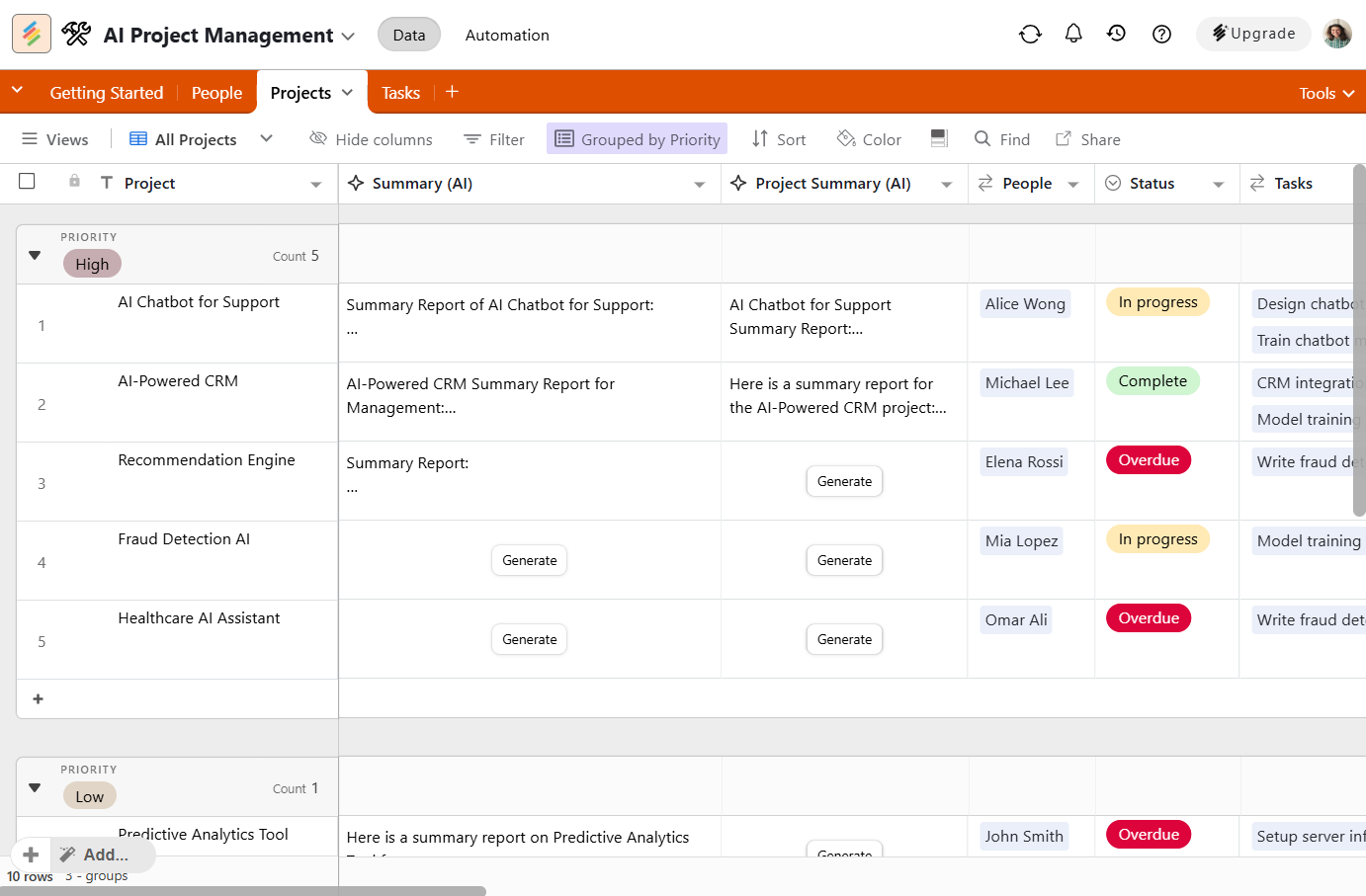
A Review column is one that we always recommend. Before an AI-generated email is sent or a budget is developed, a team member should tick a box to Approve. This provides the performance of AI and the security of human judgments.
The Future of Work is Relational
Going further into 2026, the distinction between a software and a team member is becoming unclear. Your Stackby workspace is not merely a place to keep numbers, but it is a partner. It is something that keeps in mind the information that you forget and does those things you do not enjoy.
The corporations that will conquer the decade starting in 2020 are the ones that will understand that automation does not involve getting rid of people, but rather using automation to enhance them. You get rid of the ceiling of manual labour, and you enable your team to explore novel heights of creativity.
Conclusion
The core of every high-growth company in 2026 is AI business automation. Switching to a Smart, relational database, such as Stackby, saves time and changes your course. Automating the boring work gives your team a chance to be creative. Manual workflows should not be a bottleneck. Automation is the future, and Stackby has come to realise it.
Ready to transform your business?
Create a free account with Stackby and begin creating your first AI-powered workflow today!

FAQs
Q1. How is AI automation different from regular automation?
Conventional automation is based on a fixed script. AI automation is informed by data. When the behaviour of a customer alters, an AI-based workflow is capable of changing the response, whereas a conventional workflow would simply continue to do the same.
Q2. Is Stackby hard to set up for someone who isn't a "techie"?
Not at all. Stackby was created as a no-code platform. If you can use a spreadsheet, you can create an automated workflow. We offer templates so that you can have it down in a few minutes.
Q3. Does AI automation mean I have to fire my staff?
Quite the opposite. It implies that your employees will cease to act like robots and begin to act like humans: planning, creating relations, and innovating.
Q4. What is the first thing I should automate?
Begin with the most monotonous and the large-volume activity. For many, this is a qualification of lead or the cleaning up of data. As soon as you spare yourself the time, the other will be naturally taken care of.
Q5. Is my business too small for AI?
In 2026, no business is too small. Actually, it is the small businesses that benefit most from AI since they are able to compete with their considerably bigger organizations through its ability to make the most out of their limited resources.