AI for Supply Chain Management: What Business Teams Actually Need to Know
Learn how AI is transforming supply chain management with demand forecasting, inventory optimization, logistics planning, and real-time insights. Discover the key features to look for and how to choose the right AI-powered solution for your team.
During Covid, supply chains failed publicly, and everyone watched. Empty shelves in 2021. Months-long semiconductor waits. Freight costs that tripled in a quarter. If your team was managing procurement or operations during that stretch, you don't need statistics to remind you how bad it was.
But something came out of it: AI for supply chain management shifted from a long-term IT roadmap item to an actual business priority. McKinsey estimates AI can reduce supply chain forecasting errors by 20% to 50% and cut lost sales from stockouts by up to 65%. Those aren't rounding-error improvements. They're the difference between absorbing a disruption and being crushed by one.
The problem? Most content on this topic reads like it was written for a CTO at a Fortune 500 company. If you're running a 15-person operations team or scaling a mid-market business, you need something more grounded.
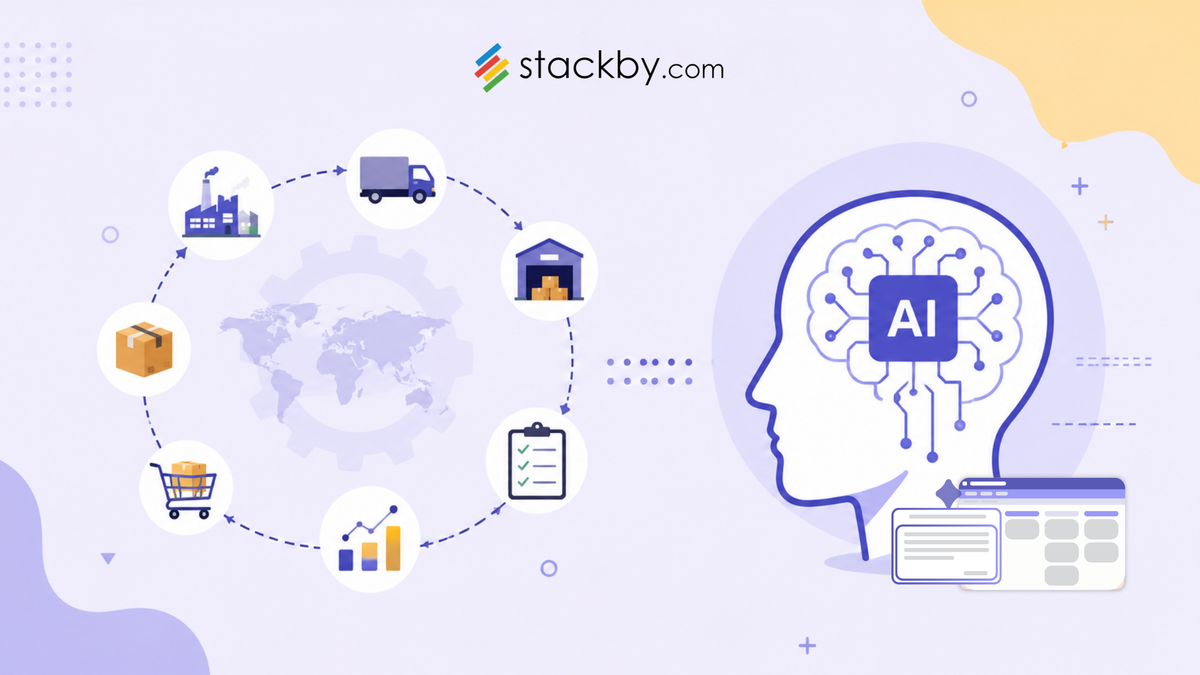
That's what this is. We'll cover what AI is actually doing inside supply chains, where the ROI lands fastest, and how platforms like Stackby help business teams apply it without needing a data science department.
Why Most Supply Chains Are Still Flying Blind
Before getting into solutions, it's worth naming what's broken. Most business teams aren't starting from a clean data foundation. They're starting from a mess.
Demand planning still runs on Excel in the majority of mid-size companies. Not "Excel plus some light automation." Actual spreadsheets, manually updated, emailed around, with version control that amounts to whoever saved the file last wins. It's genuinely frustrating to watch when you know what better looks like.
The downstream effects are predictable. Stockouts when you can least afford them. Overstock eating your warehouse budget quietly for months. Lead time estimates built on 2019 assumptions. And when something does go wrong (a supplier misses a delivery, a port backs up, a raw material price spikes), most teams find out too late to adjust cleanly.
That reactive posture is expensive. The Interos 2021 global survey put average annual supply chain disruption costs at $184 million for large companies. The businesses with the fastest recovery times had one thing in common: better data, reviewed more often, by people who could actually act on it.
That's the gap this technology is designed to close.
What AI for Supply Chain Management Actually Does
Let's be specific, because "AI" gets used to describe everything from basic rule-based automation to genuine machine learning. The distinction matters when you're evaluating tools and setting expectations.
At the simpler end: automation. Reorder triggers when stock hits a threshold. Supplier notifications sent without manual intervention. Invoice matching without a human touching every row. Useful. Not magic.
The more impactful applications involve machine learning. That's where AI reads your historical demand data, factors in seasonality, external signals (weather patterns, economic indicators, promotional calendars), and produces forecasts that consistently outperform what a human analyst generates manually. Companies like o9 Solutions, Blue Yonder, and Oracle SCM Cloud have built entire platforms around this.
Then there's the predictive layer. Supplier risk scoring. Route optimization. Anomaly detection that flags an irregular order pattern before it becomes a fraud incident. Amazon reportedly automates around 30% of supply chain decision-making now. That number keeps climbing.
And for teams looking to automate supply chain processes without enterprise software budgets, the gap between "what large enterprises do" and "what a lean team can actually access" has narrowed considerably in the last two years.
Demand Forecasting and Inventory: Where the ROI Lands Fastest
If you can only do one thing with AI in your supply chain right now, start here.
Manual forecasting fails for a structural reason. It's backward-looking by design. Your planning team is working from last year's sales data, maybe last quarter's. Markets shift faster than that. And the average human analyst can only hold so many variables simultaneously. Ten? Maybe fifteen?
AI models can process hundreds. Purchase history. Seasonal curves. Supplier lead time distributions. Web search trend data correlated to your product categories. Planners using tools like Relex Solutions or SAP IBP consistently report 15-25% reductions in excess inventory within the first year. That's cash freed up from warehouse sitting quietly depreciating.
Here's the catch though. These platforms aren't cheap or fast to implement. Relex and Blue Yonder both require significant IT resources and timelines measured in months, not weeks. For smaller teams, the more practical move is starting with a connected data workspace and layering AI forecasting APIs (Amazon Forecast, Google Vertex AI) into that structure as you scale.
The teams that win with AI inventory supply chain management aren't always the ones with the biggest tools. They're the ones with the cleanest, most centralized data to feed those tools. That part matters more than most vendors will tell you.
Key AI Use Cases Across the Supply Chain
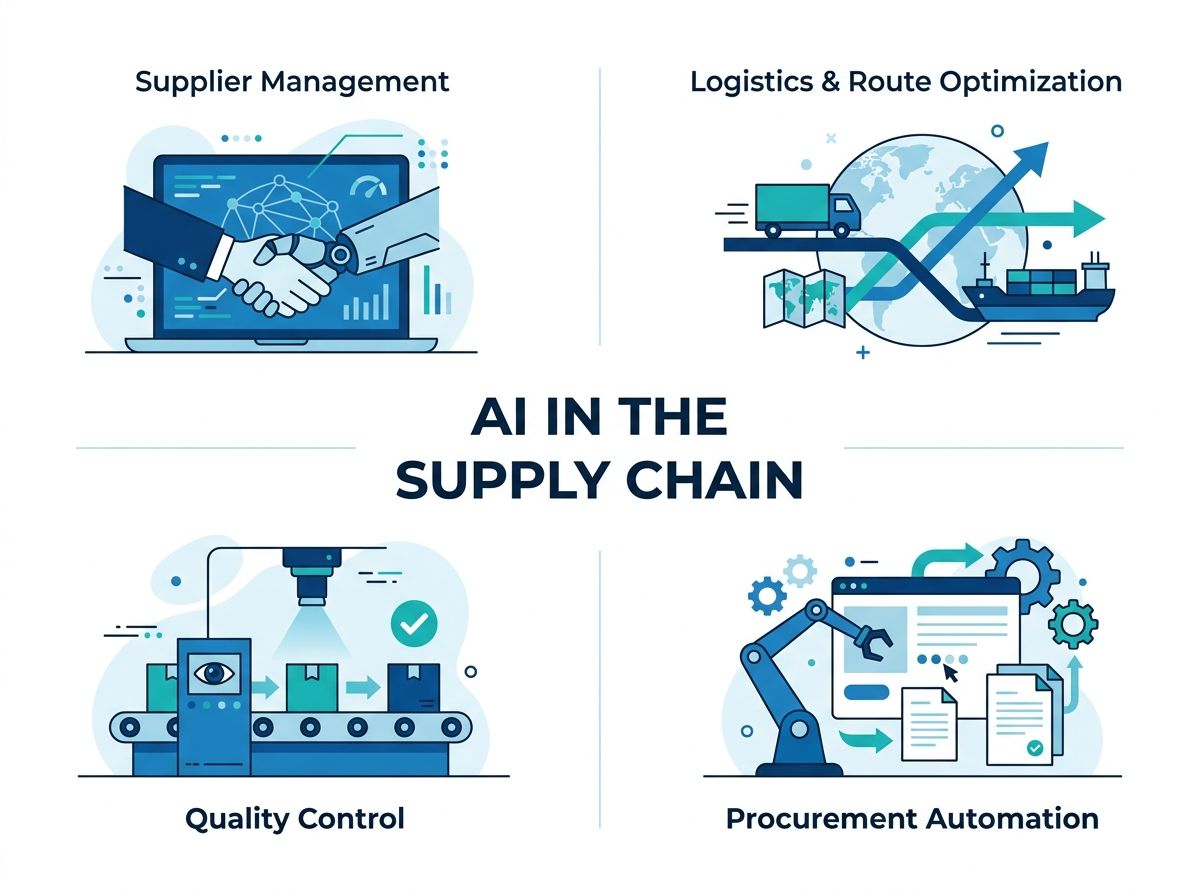
Forecasting gets most of the attention. But supply chain AI tools are running across every function now.
Supplier Management
Supplier risk is a genuine blind spot for most mid-market businesses. You onboard a vendor, sign a contract, set a reorder threshold, and then just hope. AI changes that dynamic. Modern platforms can pull financial health indicators, news signals, geopolitical data, and historical shipping performance for each supplier, then score their risk on an ongoing basis.
If a supplier's financial indicators start deteriorating six months before they miss a delivery, a well-configured AI system can flag it. A spreadsheet cannot.
Logistics and Route Optimization
This one is mature. FedEx and UPS have been running AI-powered routing for years. The technology is now accessible at smaller scales through platforms like Route4Me, OptimoRoute, and Onfleet. If your team manages last-mile distribution, the efficiency gains are real: typically 10-20% reduction in route time and fuel spend.
Quality Control
Computer vision AI is catching production defects faster and more accurately than manual inspection. Cognex and Landing AI are running actual production deployments here, not pilot programs. For manufacturing supply chains where a bad component costs multiples of its price to fix downstream, this is significant.
Procurement Automation
PO generation, three-way invoice matching, vendor reconciliation. These are genuinely automatable. If your team is still handling them manually, you're spending human hours on work a configured workflow completes in seconds. It's one of the quickest wins to identify and the most annoying when you realize how long it's been happening.
How Stackby Helps With AI for Supply Chain Management
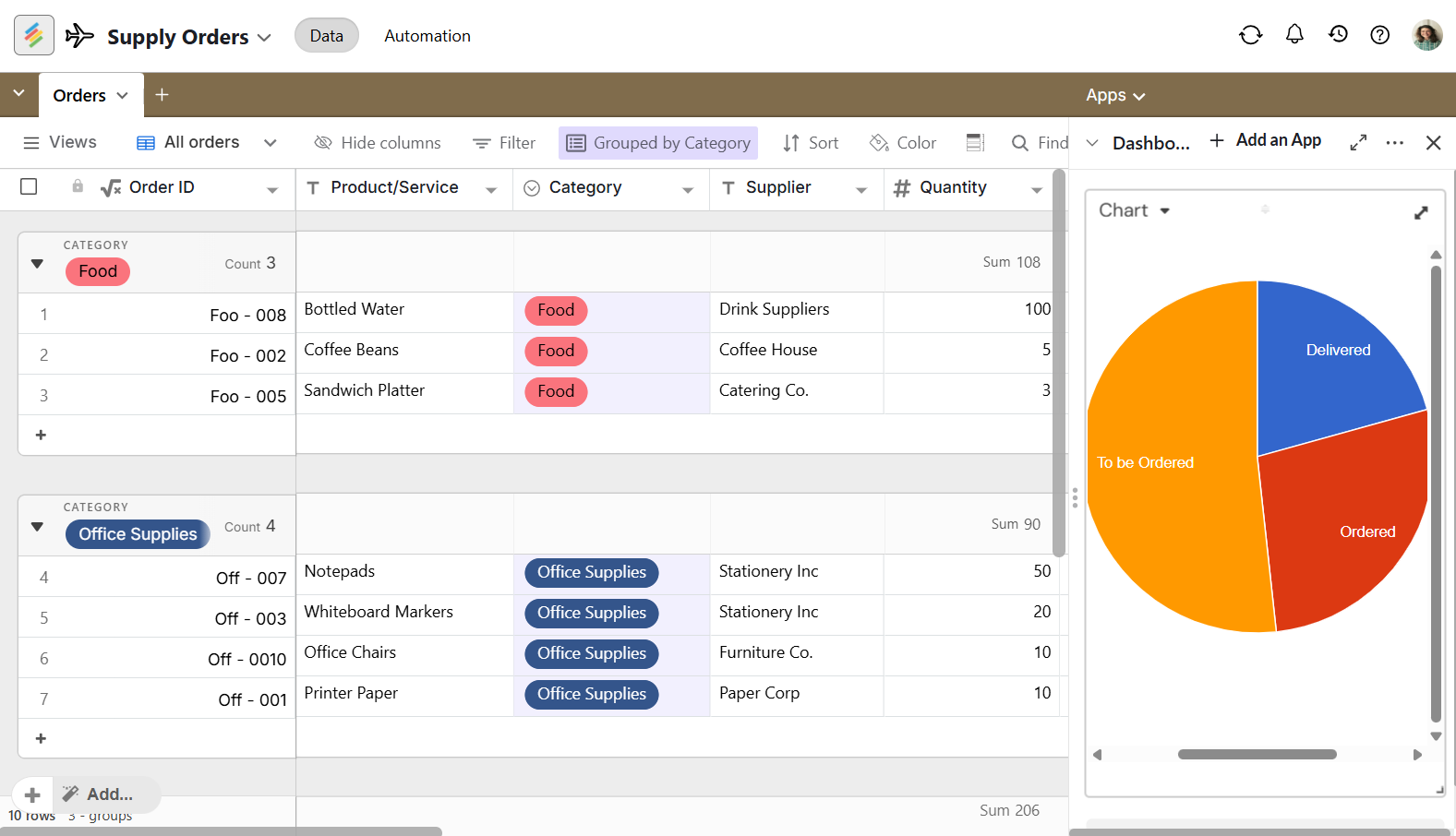
Here's where I want to get practical, because most articles on this topic stop at "go buy enterprise software" and leave lean teams with nothing actionable.
Stackby sits in a different category entirely. It's a no-code platform that blends spreadsheet flexibility with database structure and API connectivity. For operations and supply chain teams, that means you can build the data infrastructure AI tools need - without writing a line of code.
Specifically, what that looks like:
- Inventory tracking tables with real-time columns that sync via API to your supplier portals or warehouse management systems. No more copy-paste between tools.
- Supplier databases where you log contact details, performance scores, payment terms, and risk flags in one place, filterable and sortable in seconds.
- Purchase order workflows with status tracking, automated notifications, and approval chains that actually reflect how your team operates.
- Demand planning templates built on Stackby's hybrid spreadsheet-database structure, where you can pull in forecasting data from external AI tools via API connections.
- Custom dashboards that give operations leads a live view across inventory levels, supplier statuses, and order pipelines - without needing a BI team to build it for you.
The real advantage isn't just the feature list. It's that non-technical teams can configure all of this themselves. You don't wait on IT. You don't sit through a six-month implementation. You build it, connect your data sources, and you have a working command center that feeds whatever AI tools you're running on top.
If you're a mid-size operations team trying to clean up your data foundation before committing to a heavier AI platform, Stackby is a genuinely smart starting point. Schedule Demo Now to see how teams are using it for supply chain operations specifically.
Supply Chain AI Tools: A Practical Comparison
Not every team has the same needs or the same budget. Here's a clear breakdown:
The enterprise platforms are genuinely powerful. But if you're not at the scale to absorb a 9-month implementation and a six-figure contract, they're not your answer yet.
For lean teams, the smarter starting move is building clean, connected data workflows first - platforms like Stackby for operational structure, AI forecasting APIs layered on top - then graduating to heavier systems when your volume justifies it.
How to Actually Get Started: Five Real Steps
This is where most articles go deliberately vague. Let's not do that.
Step 1 - Centralize your data first. If your inventory, supplier, and order data lives in three spreadsheets managed by three different people, AI can't help you yet. One system, consistent structure, non-negotiable starting point.
Step 2 - Audit your data quality. Missing values, duplicate SKUs, inconsistent supplier naming - these degrade AI forecast accuracy before the model even runs. Fix this before buying any tool.
Step 3 - Start with one use case. Demand forecasting or reorder automation. Not both. Run it for 90 days, measure forecast error rate, then expand.
Step 4 - Connect your tools. AI APIs like Amazon Forecast and Google Vertex AI have straightforward integrations. Platforms like Stackby make this manageable for non-technical teams.
Step 5 - Keep a human review loop. The model will make mistakes early. That's expected. You learn from those errors, improve your inputs, and accuracy compounds over time. Automating before you understand the error patterns is how things go wrong quietly.
Conclusion
AI for supply chain management is real, it works, and the teams committing to it now are building an operational advantage over the ones still running on disconnected spreadsheets.
But the entry point isn't a seven-figure enterprise contract. It's clean data, the right operational structure, and one well-scoped use case to prove the model. Get that right and you have something you can actually build on systematically.
If your team is ready to stop flying blind and build something more structured, Stackby is worth a serious look. Free Signup and see what you can build in your first week.
Key Points
- AI reduces supply chain forecasting errors by 20-50%, with the fastest ROI in demand planning and inventory management.
- Real AI implementation starts with centralized, clean data - not with the AI tool itself.
- Enterprise platforms like Blue Yonder, o9, and SAP IBP are powerful but carry months-long implementation timelines; lean teams should start more modestly.
- Supply chain AI tools now cover demand forecasting, supplier risk scoring, logistics optimization, procurement automation, and quality control at every budget tier.
- Non-technical operations teams can build a connected, AI-ready supply chain foundation on Stackby without engineering support and without a long deployment cycle.
Frequently Asked Questions
What does AI for supply chain management actually involve?
It covers several distinct capabilities: demand forecasting using machine learning, automated reorder systems, supplier risk scoring, logistics route optimization, and real-time visibility dashboards. Some of it is genuinely sophisticated. Some of it is basic workflow automation that vendors rebrand as "AI" for marketing purposes. The useful question to ask any vendor: what is the model actually doing, and what data does it need to perform?
What are the leading AI platforms for optimizing supply chain management?
At the enterprise level: Blue Yonder, o9 Solutions, Relex Solutions, SAP IBP, and Kinaxis RapidResponse. For mid-market companies: Netstock and Inventory Planner offer ML-based forecasting at accessible price points. For teams building a connected operational foundation first, Stackby works well as the data layer you build other tools on top of.
How does artificial intelligence enhance supply chain resilience?
Primarily through faster signal detection. An AI system continuously monitoring supplier health data, shipping route conditions, and demand pattern shifts can alert your team to a problem weeks earlier than a human analyst reviewing monthly reports would. That lead time converts potential crises into manageable adjustments. It's not that the disruption disappears - it's that you have enough warning to respond instead of react.
Which companies offer AI-driven solutions for inventory forecasting in supply chains?
Real players in this space: Blue Yonder, o9 Solutions, Relex Solutions, Oracle SCM Cloud, SAP IBP, and Anaplan on the enterprise side. Inventory Planner and Netstock for mid-market budgets. Amazon Forecast as a standalone API for teams building custom solutions. Each has different data requirements and integration complexity, so the right choice depends on what systems you're already running.
How can AI improve demand planning in supply chain operations?
By removing the ceiling on variables a forecast can consider. A human planner realistically factors in 10 to 15 variables. An ML model can process hundreds simultaneously - seasonality, promotional calendars, competitor pricing signals, macroeconomic indicators, even social trend data correlated to your product categories. The result is consistently lower forecast error rates, which reduces both stockouts and the overstock that quietly bleeds your working capital.
What AI tools are available for real-time supply chain visibility?
Several platforms specialize here: project44, FourKites, and Descartes track shipments in real time across carrier networks. For broader supply chain visibility including supplier status and inventory positions, tools like Kinaxis, o9, and platforms built on connected workspaces like Stackby provide operational dashboards that update as your data updates.
What are best practices for integrating AI into existing supply chain systems?
Start with data hygiene, not the AI tool. Clean, centralized, consistently structured data is the prerequisite - without it, you're feeding a sophisticated model garbage and getting garbage back. Then pick one well-scoped use case, run a 90-day pilot with specific measurable KPIs, review results honestly, and expand from there. API-connected platforms like Stackby make integration with AI tools manageable for non-technical operations teams. The teams that struggle most are the ones who try to automate everything at once.